What is a qualified lead? Why it beats a bigger list
Fifty companies with a reason to buy beat a thousand random contacts. What makes a lead qualified, how to judge one quickly, and why Seekpitch prices by them.
· 5 min read
It is tempting to measure outreach by the size of the list. Ten thousand contacts sounds more impressive than two hundred. Yet the businesses that get the best results from outreach usually work with smaller lists, chosen with more care. The difference comes down to one idea: the qualified lead.
What is a lead?
A lead is a company, or a person at a company, that might become a customer. On its own, the word says nothing about how likely that is. A lead could be a perfect match or a complete stranger to your market.
What makes a lead qualified?
A qualified lead is one with a clear, specific reason to need what you sell. For a business-to-business company, that reason is usually visible from the outside if you know where to look. A lead is generally qualified when it meets three conditions:
- It fits your customer profile. It is the right kind of business, of the right size, in a place you can serve.
- It shows a sign of need. Something about the company suggests the problem you solve is present now. Examples include hiring for a role your product supports, opening new locations, or offering a service that depends on what you sell.
- There is someone to talk to. You can identify a person who would make or influence the decision, and reach them.
If you cannot say in one sentence why a particular company should hear from you, it is probably not qualified yet.
Why list size can be misleading
Large, loosely targeted lists cause several problems at once:
- Lower replies. Emails to people with no need for your product are ignored or deleted.
- More spam complaints. Irrelevant messages are far more likely to be reported, which damages your ability to reach the people who would have been interested.
- Generic writing. When a list is too broad, the message has to be vague enough to fit everyone, and it ends up speaking to no one.
- Wasted time. Every irrelevant reply, bounce and unsubscribe takes attention away from real opportunities.
By contrast, a list of qualified leads lets you write something specific, reach the inbox more reliably, and spend your time on conversations that can lead somewhere.
How to judge a lead in under a minute
When you review a list, you do not need to research each company in depth. Ask four quick questions:
| Question | What a good answer looks like |
|---|---|
| Is this the right kind of business? | It matches the type and size of your best existing customers. |
| Is there a reason to act now? | A visible sign, such as a new branch, a job advert or a service that relies on your product. |
| Can we serve them? | They are in a region, language and market you can support. |
| Is there a person to contact? | A named decision-maker, ideally with a checked email address. |
If the answer to any question is no, set the lead aside. It is better to send fifty emails that matter than five hundred that do not.
How Seekpitch finds qualified leads
Seekpitch is designed around qualification. You paste your website, and the agent works out what you sell and who buys it. It then searches for companies that may fit, reads each one's website, including team and careers pages, and keeps only those that show a reason to buy. Next to every lead, it writes that reason in a sentence, so you can judge it at a glance.
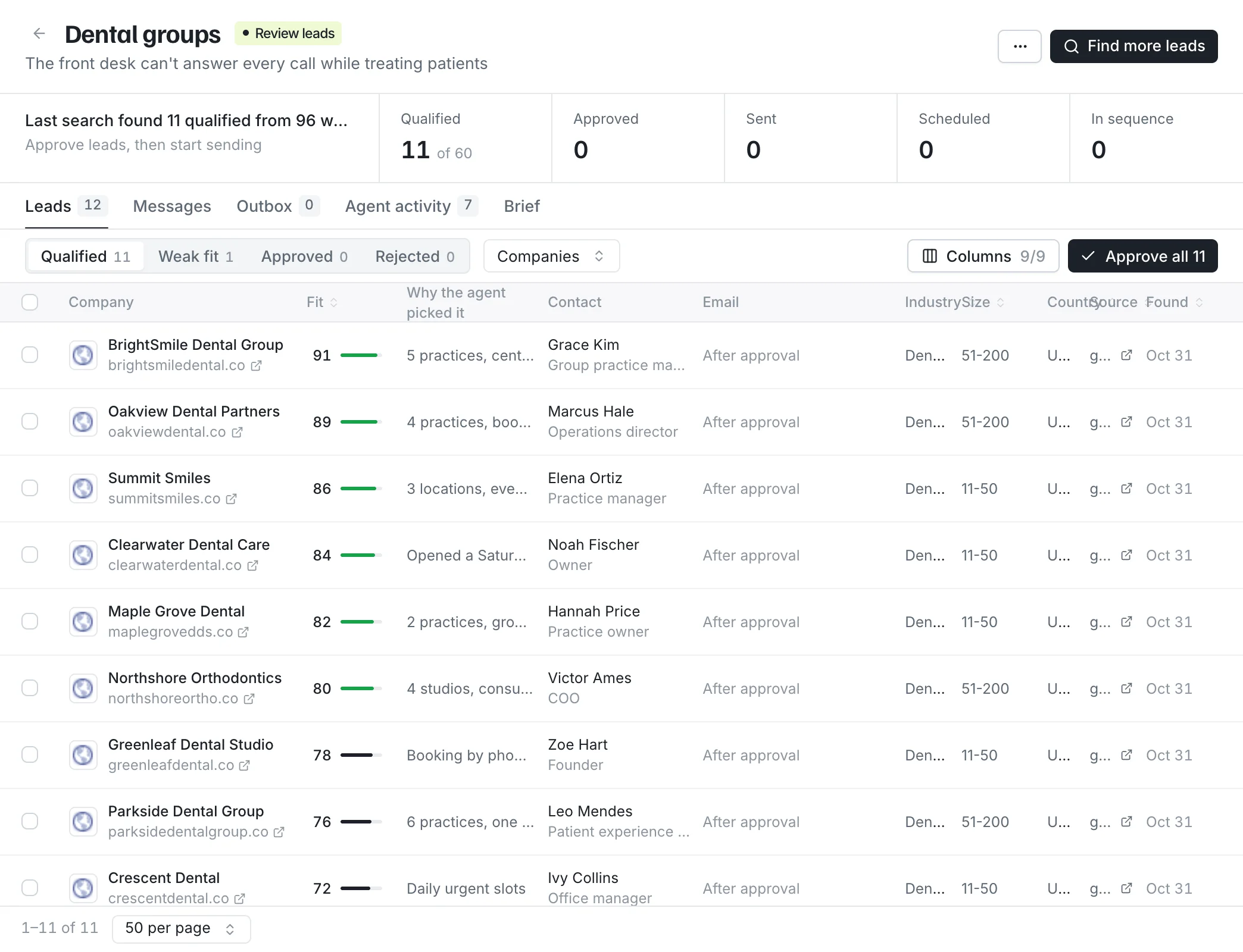
Leads come from reading public company websites rather than from bought contact lists. Email addresses published on a company's own site are used first. Where none is published, Seekpitch checks likely addresses with its own verifier and clearly labels any it could not confirm, so you decide whether to use them.
Nothing is contacted automatically. Every list waits for your approval, and you can remove any lead you are not sure about.
Why we price by qualified leads
Many outreach tools charge by the number of emails sent or by credits. That model rewards sending more, whether or not the emails are wanted. We think that is the wrong incentive, both for you and for the people receiving your emails.
Seekpitch plans are priced by qualified leads: companies the agent has researched on their live website and found to be a fit, with the reason written next to them. Leads that do not fit are never counted. There are no per-email fees, so sending follow-ups or adding mailboxes never increases your bill. If you import your own leads, each one uses one lead from your allowance and is checked in the same way.
You can see how many qualified leads each plan includes on our pricing page. The free trial includes 50 qualified leads over 7 days, which is usually enough to see whether the leads match the customers you want.
Improving the quality of your leads over time
- Describe your best customers precisely. The more specific your description, the more specific the search.
- Reject freely. Removing leads that are a poor fit helps you see patterns in what does and does not suit you.
- Learn from replies. If one type of company replies more often, create a campaign focused on that group.
- Keep your facts current. When you add a new service or a new kind of customer, update your Company & facts so the agent looks for the right signals.
In summary
A qualified lead is a business with a clear reason to need what you offer, right now, and a person you can reach. Fewer, better leads produce more replies, fewer complaints and better conversations. That is why Seekpitch explains every lead it finds, and why you only pay for the ones that fit. Compare the plans to find the right number of leads for your business.
Paste your website. Get leads that fit.
Try it free for 7 days with 50 qualified leads. No card needed, and nothing is sent without your approval.